
How to Support Veteran Businesses: A Practical Guide
Editorial Team
Table of Contents
- Why Supporting Veteran Businesses Matters More Than Ever
- The Real Benefits of Supporting Veteran Entrepreneurs
- Understanding Veteran-Owned Business Certification
- How to Find Veteran-Owned Businesses Near Me
- Supplier Diversity Programs and Procurement Goals
- Beyond Shopping: Community Integration and Consumer Advocacy
- Measuring Impact: Post-Grant Success and Long-Term Sustainability
- Conclusion
- Frequently Asked Questions
Last Updated: September 17, 2026
Why Supporting Veteran Businesses Matters More Than Ever
Veteran-owned companies employ millions of people and anchor communities across the country. Yet many never reach their full potential because buyers don't know they exist. Knowing how to support veteran businesses starts with one shift: treat them as serious suppliers, not charity cases.
That distinction matters. This guide from Global Wellness Alliance, founded by a disabled combat veteran, walks through the practical steps: certifications, directories, supplier programs, and the community moves that keep veteran businesses alive.

Veteran entrepreneurs often run lean operations with strong logistics and discipline. What they lack is access. Larger buyers rarely know how to find them or verify their status.
Below, we cover exactly how to find, vet, and buy from veteran-owned companies. We also explain how to track whether your support actually helps.
The Real Benefits of Supporting Veteran Entrepreneurs
The benefits of supporting veteran entrepreneurs go beyond goodwill. Veteran-owned firms tend to hire other veterans, keep jobs local, and reinvest in their communities.
Here's what changes when you buy veteran:
- Jobs stay local. Veteran firms often hire within their own networks.
- Supply chains diversify. New vendors mean less reliance on a handful of big players.
- Communities gain role models. Visible veteran business owners encourage others to start.
- Your spending does double duty. One purchase supports a family and a local economy.
Many buyers assume veteran-owned businesses only sell tactical gear or apparel. That's wrong. Veterans run construction firms, logistics companies, marketing agencies, and wellness brands.
The real value is resilience. Veterans build businesses that survive hard years because they've already survived harder ones.
Understanding Veteran-Owned Business Certification
Veteran-owned business certification is an official status confirming that a company is majority-owned and controlled by a veteran. It is the difference between a marketing claim and a verifiable fact, and it is what unlocks federal contracting, corporate supplier diversity programs, and state procurement lists.
Certification matters because anyone can print "veteran-owned" on a storefront. Verification separates real status from a slogan.
Key Certifications: VOSB, SDVOSB, and 8(a)
Three designations carry the most weight with buyers:
- VOSB (Veteran-Owned Small Business): At least 51% owned and controlled by one or more veterans. The veteran must manage day-to-day operations and hold the highest officer position.
- SDVOSB (Service-Disabled Veteran-Owned Small Business): Same 51% ownership and control test, but the veteran owner must have a service-connected disability as determined by the VA. SDVOSBs qualify for the most set-aside contracts.
- 8(a) Business Development: An SBA program for socially and economically disadvantaged owners, including many veterans. It is not a veteran-specific certification, but it stacks with VOSB/SDVOSB status and opens sole-source awards.
Each requires documentation: DD-214 discharge papers, ownership records, operating agreements, and control verification. The SBA's contracting assistance programs lay out the eligibility rules in detail.
Self-Certification vs. Third-Party Verification
This is the distinction most buyers miss. A business can self-certify as veteran-owned by registering in the federal System for Award Management (SAM) and attesting to its status. That is legal and often sufficient for small purchases.
For larger contracts and corporate supplier programs, buyers usually want third-party verification from an approved entity, most commonly the National Veteran Business Development Council (NVBDC) or the VA's Center for Verification and Evaluation (CVE) for SDVOSB status.
How Certification Opens Federal Contracting Doors
Federal agencies operate under an annual goal, set at 3% of prime contract dollars, for awards to service-disabled veteran-owned small businesses, with additional goals for VOSBs at the subcontract level. Certification puts a business into the databases agencies actually search, including SAM.gov and the SBA's Dynamic Small Business Search.
What Buyers Should Ask Before They Commit
A short verification script saves everyone time:
Affiliate Activation - One Time Fee →
- "Which certification do you hold, VOSB, SDVOSB, or both?"
- "Who verified it, and when does it expire?"
- "Can you share your SAM.gov UEI or your NVBDC certificate number?"
- "What percentage of the business do you own and control?"
A legitimate veteran-owned business will answer all four in under a minute. Hesitation is a signal.
How to Find Veteran-Owned Businesses Near Me
Search "veteran-owned businesses near me" and you'll get scattered results. A better approach is to use verified directories, then confirm status yourself.
Online Directories and Verification Tools
Start with these sources:
- SBA's Veteran Business Outreach Centers: Local counseling plus referrals.
- National Veteran Business Development Council: Maintains a verified directory.
- State procurement portals: Many list certified veteran vendors.
- The VA's vendor database: For firms selling to federal agencies.
Cross-check any business you find against at least two sources. Directories go stale.
Supplier Diversity Programs and Procurement Goals
Supplier diversity programs are corporate and government initiatives that reserve a share of spending for underrepresented vendors, including veteran-owned businesses.
Here's how to plug in:
- Ask your employer or company if it has a supplier diversity policy.
- Request the veteran-owned spend target.
- Nominate a veteran vendor you already use.
- Track whether the goal is actually met.
Beyond Shopping: Community Integration and Consumer Advocacy
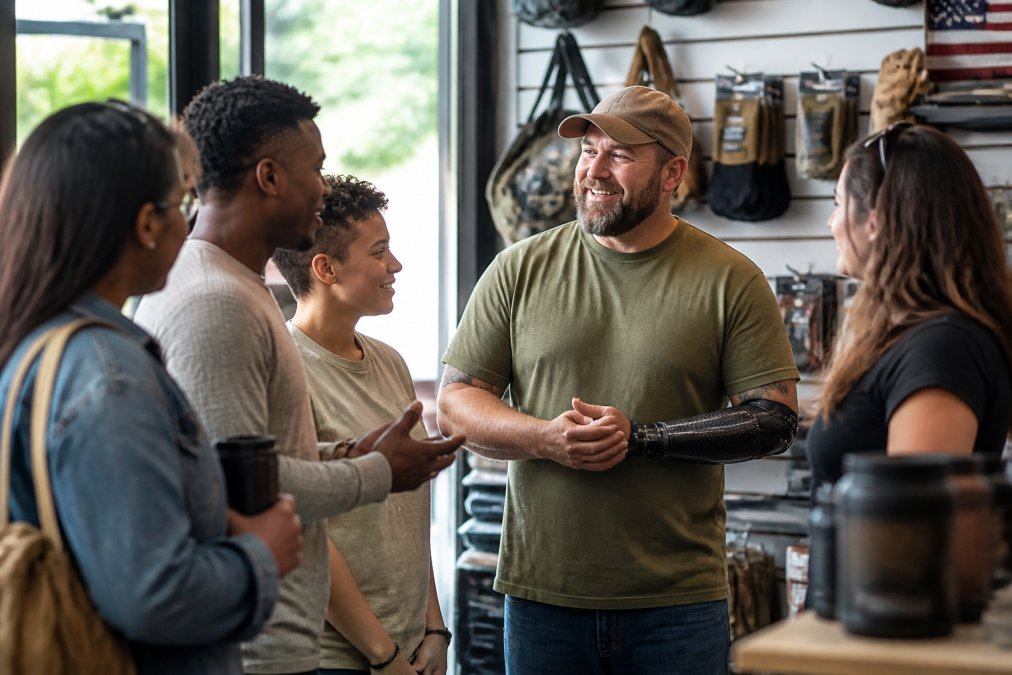
How to Spot a Veteran-Owned Business Without a Directory
Directories are incomplete. Many veteran owners never certify because the paperwork is not worth it for a small storefront. Here are the signals that show up in the wild:
- Storefront signage. Look for a small decal or window sticker, VOSB, SDVOSB, or a chamber-issued veteran-owned badge. These are usually placed near the register or the front door, not on the main sign.
- The owner's bio. Check the "About" page or the back of the menu. Phrases like "served in the Marine Corps," "Army veteran," or "after 20 years in uniform" are the tell.
- Hiring language. Job postings that mention veteran-friendly scheduling or a veteran hiring commitment usually signal a veteran-led operation.
- Local veteran service organizations. Your local American Legion, VFW, or Veterans of Foreign Wars post keeps an informal list of member-owned businesses. Ask the post adjutant, they usually know.
- Chamber of commerce member directories. Many chambers tag veteran-owned members even when no federal certification exists.
A Simple Prioritization Framework for Everyday Spending
You cannot redirect every dollar. You can redirect the ones that matter. A workable pattern most consumers land on:
- High-frequency, low-stakes purchases first. Coffee, lunch, car washes, oil changes, dry cleaning. These are the easiest to shift and they generate the steady repeat revenue that keeps a small business alive.
- Recurring services second. Lawn care, HVAC, plumbing, bookkeeping. These are often the highest-value contracts a veteran-owned firm can win from a household.
- One-time big purchases third. Furniture, appliances, a vehicle. Vet the certification before you commit real money.
- Skip the guilt. If a veteran-owned option does not exist in a category, buy what you need. The goal is prioritization, not purity.
Community Integration That Actually Moves the Needle
Buying is the easy part. Integration is what keeps a veteran business open past year three. Consumer advocacy means telling other people, but the highest-leverage moves go further than a five-star review:
- Attend local events where veteran vendors sell. Farmers markets, holiday markets, and chamber mixers are where veteran-owned businesses get their first repeat customers.
- Partner on a project instead of just purchasing. Hire a veteran-owned firm for a one-off job, a website rebuild, a catering order, a landscaping project, and treat it as a paid audition for ongoing work.
- Offer professional skills for free. Bookkeeping, web help, photography, and legal review are the services veteran owners most often cannot afford in year one. Two hours of your expertise can be worth more than a $200 purchase.
- Introduce, don't just endorse. A warm introduction to a procurement manager or a fellow business owner converts far better than a social media share.
- Share their story, not just their discount. Veteran-owned businesses do not need pity marketing. They need to be described as competent suppliers.
Measuring Impact: Post-Grant Success and Long-Term Sustainability
Track these signals:
- Revenue stability: Is the business growing or flat?
- Staffing: Has it hired since you started buying?
- Repeat customers: Are others coming back?
- Certification renewal: Did it stay certified?
Business sustainability comes from steady demand, not one-time grants. Your repeat business is the metric that counts most.
Conclusion
Finding and supporting veteran-owned businesses takes more effort than a quick search, but the payoff reaches further than one purchase.
Frequently Asked Questions
How can I verify if a business is veteran-owned?
Check for certifications from the Small Business Administration (SBA) or the National Veteran-Owned Business Association (NaVOBA). Many businesses display their VOSB or SDVOSB status on their website or storefront. You can also use the SBA's Veteran Small Business Certification (VetCert) database to confirm a company's status. Ask the owner directly, as many veteran entrepreneurs are proud to share their story and service background.
What are the benefits of shopping at veteran-owned businesses?
Shopping at veteran-owned businesses keeps money in local communities, supports job creation, and helps veterans transition to civilian life. These businesses often bring unique leadership skills, discipline, and resilience from military service. Supporting them also strengthens supplier diversity and promotes economic development. Many veteran-owned brands, like Global Wellness Alliance, give back to the veteran community through employment and mentorship.
Are there grants for veteran-owned businesses?
Yes, several federal and private grant programs exist for veteran entrepreneurs. The SBA offers funding through programs like the Veterans Business Outreach Center (VBOC) and the Military Reservist Economic Injury Disaster Loan. Private organizations such as the Bob Woodruff Foundation and the PenFed Foundation also provide grants. Eligibility varies, so check each program's requirements and apply early, as funds are often limited.
Do veteran-owned businesses get a tax break?
Federal tax breaks for veteran-owned businesses are limited, but some states offer incentives. The SBA's HUBZone program provides contracting preferences, not tax breaks. However, the Work Opportunity Tax Credit (WOTC) allows employers to claim credits for hiring veterans. Check with your state's economic development office for local tax incentives. Always consult a tax professional to confirm what you qualify for.